

Watching the final season of Stranger Things hit me in a way I wasn’t expecting and I think it has to do with my newfound understanding of Dungeons and Dragons (DnD). The whole series had me ready to give the Duffer Brother’s a huge shout out for taking DnD mainstream.
Not that you’ll ever catch me playing. NERDS! (but if you invited me OF COURSE I’D COME PLAY... nerds.)
I’ve been around DnD most of my life, but never played it myself. I never realized the powerful story telling that can be crafted out of those fantasy books. Whatever you think about how the show ended, the story had us ALL sucked in for the better part of decade. But, I was left with some questions.
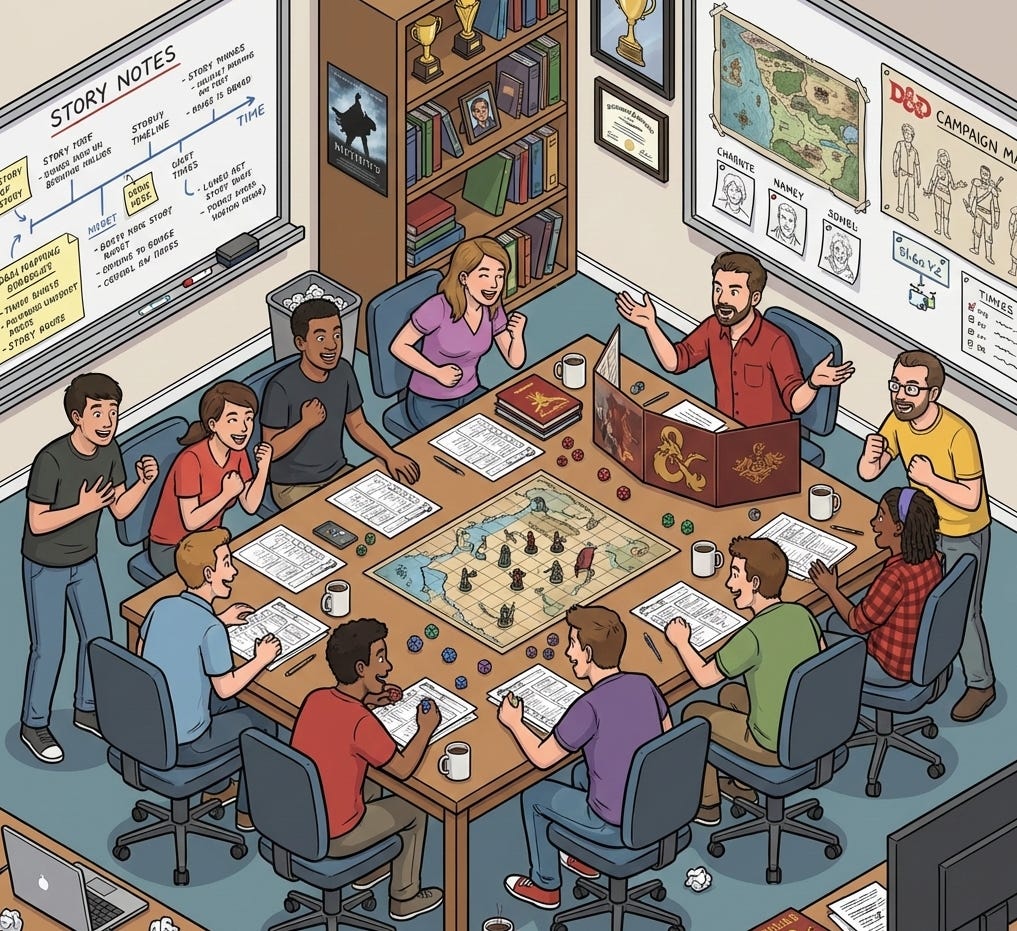
The Duffers Barely Know DnD (And It Shows)
I was curious if the The Duffer brothers actively played DnD as part of the writing process for Stranger Things. To me that made sense. The way the story and plot unfolded from show to show, and season to season, it felt like a long running campaign played over the course of a summer break. There was no shortage of theories that the ending would be, “they were playing DnD the whole time,” which I take as a good endorsement of my curiosity.
Turns out they didn’t, or at least not really. Ross Duffer admitted it himself. In 2025, Ross said to Collider, “We grew up actually playing Magic: The Gathering. We did dabble in D&D, but my knowledge is embarrassingly low, considering how important it is to the show.”
WHAT! Ross! That’s wild that you wrote a show about DnD!
The show’s entire mythology is from DnD (the Demogorgon, the Mind Flayer, Vecna) and they were working from vibes, not experience. Now, imagine what they could’ve done if they’d actually run campaigns while writing. Which brings me to my ask: Netflix should mandate DnD for its writers’ rooms. Not as a gimmick. As a disciplined process.
DnD is a Storytelling Cheat Code
A Dungeon Master builds a campaign. They decide the enemies, the difficulty, and the possible paths the players take on their march to glory. But here’s the thing; characters can and will die in completely random ways. The dice don’t care about your story arc or your hero’s tale. That randomness mirrors real life, and it’s what separates “well, that was pretty good story” from “I’ll remember this forever and my life is fundamentally changed from this moment going forward.”
Stephen King calls it “kill your darlings.” He preaches that you must be willing to cut what you love for the story’s sake. He wrote in On Writing: A Memoir of the Craft, “Kill your darlings, kill your darlings, even when it breaks your egocentric little scribbler’s heart, kill your darlings.”
DnD can force you to do this. You can’t give a character plot armor when the dice say they’re dead. Eddie Munson’s death in Season 4 hit hard precisely because it felt earned, not inevitable.
As an example, let’s play out how this might look if they were actually playing a campaign in the writer’s room.
Eddie loses his defending dice roll against those crazy bat things. All his health is gone. Everyone groans and one person yells that it was a terrible idea to have him charge off alone like that; “What were you thinking Barry?! It’s like you wanted him to die!”
Once things calm down, Barry then proceeds to lose all of Eddie’s death saving throws. And, since he was stranded and alone in the Upside-Down, it wouldn’t have mattered much anyways. There was no one around to heal him even if he succeeded.
Eddie is gone. Remove him from the board.
But alas in the end, Stranger Things (like so many stories) needed more moments where the rules of the world mattered more than anything else, fans included.
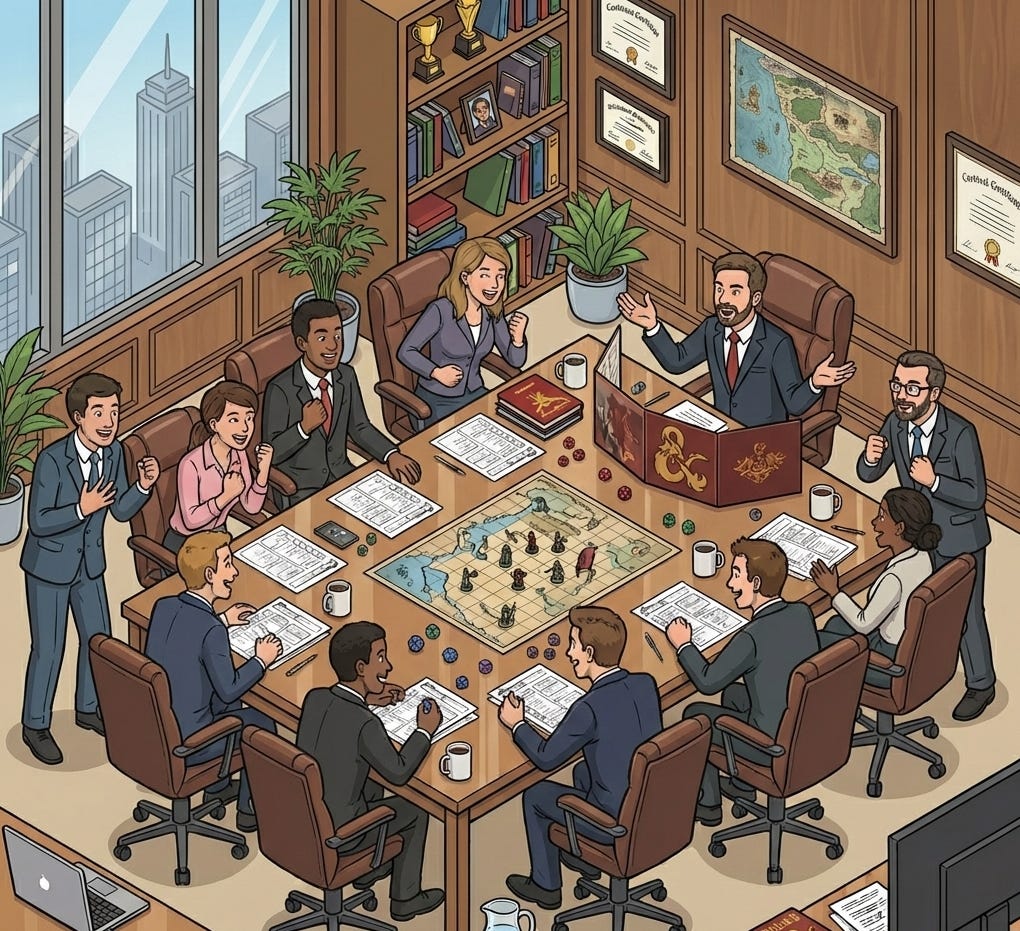
The Ending Had “Network Executive” Written All Over It
Let’s talk about Stephen King again and specifically his endings. The man has had some rough ones. The Stand ends with “the literal Hand of God appearing in the sky above a double-crucifixion to set off a nuclear warhead.” It has a name, deus ex machina. You may know it more commonly as “Hollywood Magic.” Sometimes we write ourselves into a corner and that’s ok. But instead of just saying, “it was aliens the whole time,” remain calm, back out slowly, and do some revising and heavy editing.
Stranger Things didn’t go full Hand of God, but it got pretty damn close. The ending made the overall story feel complete; I’ll give it that. But it betrayed a lot of what we came to expect from the previous seasons. It was a little bit too neat and clean.
I think of it as an overly polite version of how The Little Prince concludes. The reader is left with the choice to decide how the story lives on in your heart. Either Eleven’s trials are finally over and she’s at eternal rest after making the ultimate sacrifice for the good of all humankind, or she somehow crossed multiple state lines, cleared customs as an unaccompanied minor, bought suspiciously modern hiking gear, and wandered into the Norwegian wilderness alone, which, we all know, her favorite thing was being alone.
Sometimes death really is the best ending and the show didn’t commit.
Netflix Needs This More Than They Know
I do think there’s a studio that does their own version of mandating dungeons and dragons in the production meetings to great success: A24. Their version is give autonomy to filmmakers who don’t want to follow formulaic concepts. Their films are “sometimes outwardly risky and at other times deceptively so,” appealing to audiences “drawn to unconventional fare.” (Producer’s Toolbox) They’re not copy-pasting. Their not focus group testing. They’re letting complexity breathe; just like real life. This is an incredibly difficult thing to do, which is why some big companies might need a bit of a cheat code to pull it off.
Netflix is going the other direction from A24. From 2020 to 2024, they increased original films from 15.5% to 19.8% of their library. BUT - audience demand for those originals dropped from 28.3% to 12.3%. (TVREV) More output, less interest. The early magic is dwindling quickly.
DnD campaign building is the cheat code Netflix needs. With it, you get a forcing factor for creating complex, rich stories that mimic the sometimes delightful, and sometimes devastating, randomness of real life. If you’re a major streaming outlet whose storytelling has been slipping for years, this is your answer.
Please, Netflix, don’t just copy and paste Stranger Things. Make those writers play DnD.
And if you won’t, I might. I’m thinking about cobbling together some stories myself. Learning the system. Finding a group. Nothing like on-the-job training. Shall we play some DnD together?