

What we carried this week...
We're not going to lie; it was hard to sit down and write and record this week. The world is loud right now. But then the Connecticut Sun got sold for $300 million to a family that already owns the Rockets, and a robot called its first strike in a major league game, and a jury told Mark Zuckerberg his company built an addiction engine on purpose. It hit us that sports, media, all of it, these aren't distractions from the big stuff. They are the big stuff. The same people making the same moves for the same reasons.
The Comets Are Back. The Sun Are Gone. And the WNBA Just Showed You How Leagues Really Work.
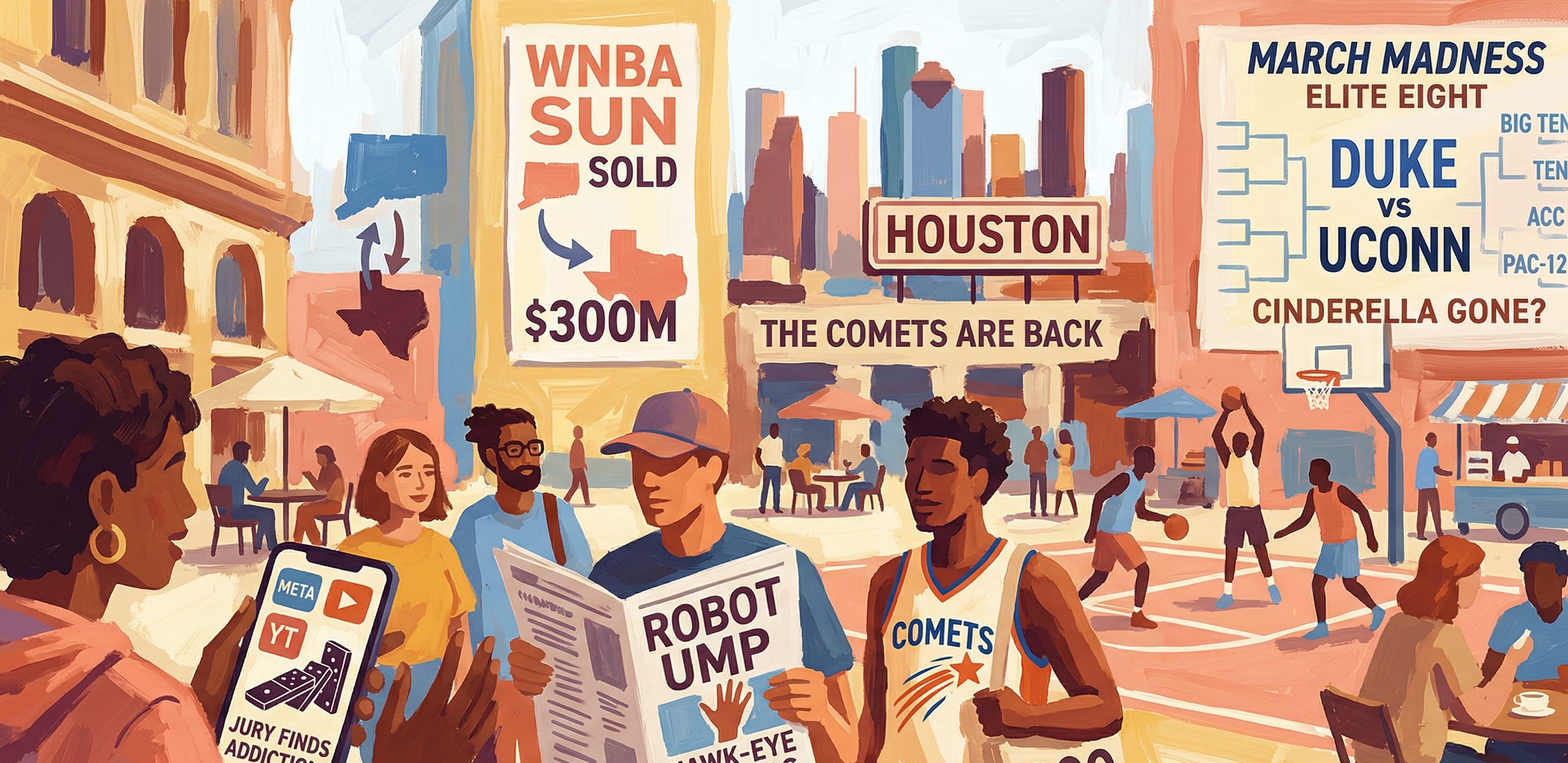
The Fertitta family, owners of the Houston Rockets, bought the Connecticut Sun for $300 million and will move the franchise to Houston after the 2026 season. The team will rebrand as the Comets, resurrecting the name of the original WNBA dynasty that won four straight titles before folding in 2008.
The price is a record for the WNBA. For context: the Atlanta Dream sold for under $10 million in 2021. That’s a 30x jump in five years. The Mohegan Tribe, which made history as the first Native American tribe to own a professional sports team when they bought the franchise in 2003, exits the league entirely.
The sale feels like a bellwether. Real money is flooding into women’s basketball (a new $2.2 billion media deal, a salary cap that jumped from $1.5M to $7M, six expansion teams by 2030). But the way it happened tells you more than the price tag: the league blocked two higher offers to steer the team where it wanted it to go. The WNBA is growing. It’s also consolidating power.
Baseball’s Robot Umpire Is Here. The Question Is Whether You Wanted It.
MLB debuted the Automated Ball-Strike Challenge System on Opening Night for the Yankees-Giants, which was also the first-ever live MLB game on Netflix. Players can now challenge ball and strike calls by tapping their helmet. Each team gets two challenges; lose both and you’re done. José Caballero became the first player to use it in a regular-season game. He lost. The umpire was right. The 12 Hawk-Eye cameras confirmed it.
The system works. Umpires are still apparently pretty good and most of their misses are on pitches that barely clip the zone. But once you’ve conceded that the machine is the final authority on whether a call is right, you’ve quietly eliminated the case for having the human there at all.
And here’s the thing nobody’s saying out loud: the blown call is part of the game. The argument at the plate, the manager kicking dirt, the bar erupting because the ump squeezed the zone in the seventh; that randomness is part of why sports feel alive. Perfectly measured rules might produce a fairer product. Whether it produces a more fun one is a different question.
Meta and YouTube Built an Addictive Machine. A Jury Just Said So. Now What?
A Los Angeles jury found Meta and YouTube liable on all counts in the first social media addiction case to reach a verdict. The plaintiff, a 20-year-old California woman identified as Kaley, testified that she started using YouTube at age 6 and Instagram at 11, and that the platforms fueled depression and suicidal thoughts. The jury awarded $3 million in compensatory damages (Meta 70%, YouTube 30%) plus $3 million in punitive damages. The day before, a separate New Mexico jury hit Meta with $375 million for failing to protect children from predators on its platforms.
The money is negligible for these companies. The precedent is not. The legal strategy that worked here was targeting the design of the platforms rather than the content on them. Internal documents showed Meta allowed beauty filters despite 18 of its own experts warning they could harm users. The Big Tobacco comparison keeps surfacing, and for good reason: same pattern of internal knowledge, public denial, eventual reckoning. Both companies plan to appeal. This will take years. But there are thousands of consolidated cases waiting behind this one, and the first domino just fell.
March Madness Delivered the Bracket TV Execs Dreamed Of. Is That a Problem?
The Elite Eight is set: Duke vs. UConn, Michigan vs. Tennessee, Purdue vs. Arizona, Illinois vs. Iowa. For the second straight year, every team in the Sweet 16 came from a high-major conference. The closest thing to a Cinderella is 9-seed Iowa. The Hawkeyes have won three tournament games in a week after winning four in the previous 24 years.
The NCAA tournament has a brand built on chaos but this year’s Elite Eight feels mild and almost predictable, and there are structural reasons why. NIL and the transfer portal funnel talent upward. The mid-majors that used to shock the world are now farm systems for the programs they once beat. Duke-UConn in the Elite Eight is great television. But March Madness was never really about the best teams winning. It was about the feeling. When the house always wins, what’s left? Ratings, probably. Magic, probably not.
We’re still standing
It’s a tough world out there right now for many of us and we hope you’re all keeping above water.
— Will, Steph, & Jamie