


What we carried this week...
The World Cup has ended, and it left behind a story with many angles: the field got bigger, and governing organizations showed they play by their own, unpublished rules. Forty-eight teams opened the tournament and new nations joined what felt more like a celebration of the world than ever before. Meanwhile the machinery around the game (the offside chip, the review booth, the White House and FIFA) spent the same month deciding exactly what we get to see and who gets credit for it.
In the end Spain managed the final match like they owned the MetLife Stadium and took home the win. It wasn’t pretty, but in the chaos there were very few moments where Spain didn’t look in total control. They bullied Argentina up and down the pitch, and it showed in the lack of sportsmanship showed by Argentina in the end. However, their show of emotion was dwarfed by the unsportsmanlike conduct of those governing the sport off the field.
That tension is the whole issue. Openness at the edges, control at the center. Every story below is one or the other, and two of them are both.
Cape Verde forever
Naysayers claimed the expanded field would water down the World Cup. Instead it gave us Cape Verde: at 525,000 people it is the smallest country by land area ever to qualify. They claimed a draw with Spain 0-0 in their first World Cup match, then Uruguay 2-2, then walking out of Group H as the smallest nation ever to reach the knockout rounds. The were tied with Argentina 2-2 at full tiem and it required some controversial refereeing in extra time to get Argentina through.
Fox spent the last week pointing out that the two teams in the final both got held to a draw (in regulation) by the debutant nobody thought would even score a goal.
I’ve watched this tournament my entire life, and for most of it the World Cup was a rotation: a couple of European teams play against Brazil and everyone else is an extra on the set. This time if felt like the world’s tournament instead of Europe’s tournament with guests. More teams meant more first times, and first time experiences are the whole point. Nobody remembers the group-stage results between two former champions. Everybody who watched will remember Cape Verde.
Expansion didn’t dilute the World Cup. The diversity among nations improved competition (which diversity always has a knack of doing).
-Will
A sport decided by microns is accurate, and worse
Last issue we wrote that the villain isn’t a bad ref, it’s a good chip. In the World Cup, technology ran the show. Iran went home because semi-automated offside found a toe in the wrong place on a set piece, a call that was correct under the law and absurd to every human watching. When Qatar played Switzerland, the system had a “technical outage” at the decisive moment and FIFA asked everyone to simply trust the call.
This tells you what the technology that’s so accurate it could measure offsides by a single micron; not truth, authority.
Measuring offside to the millimeter has not made soccer better, or more enjoyable to watch. The technology is precise about the calls nobody argues about and useless for the ones everybody does (penalties, handballs, red cards). Those are all still judgment calls that VAR only touches on. Offside was written to stop goal-hanging, not to disallow goals by the width of a pinky toe. A rule enforced beyond its purpose stops being the rule.
Our Bet?: IFAB rewrites the offside law toward a “daylight” standard (where an attacker must be clearly past the defender) before the 2030 World Cup. The Iran call made the current law politically indefensible.
We built a machine to end arguments, and it turned the argument into the content.
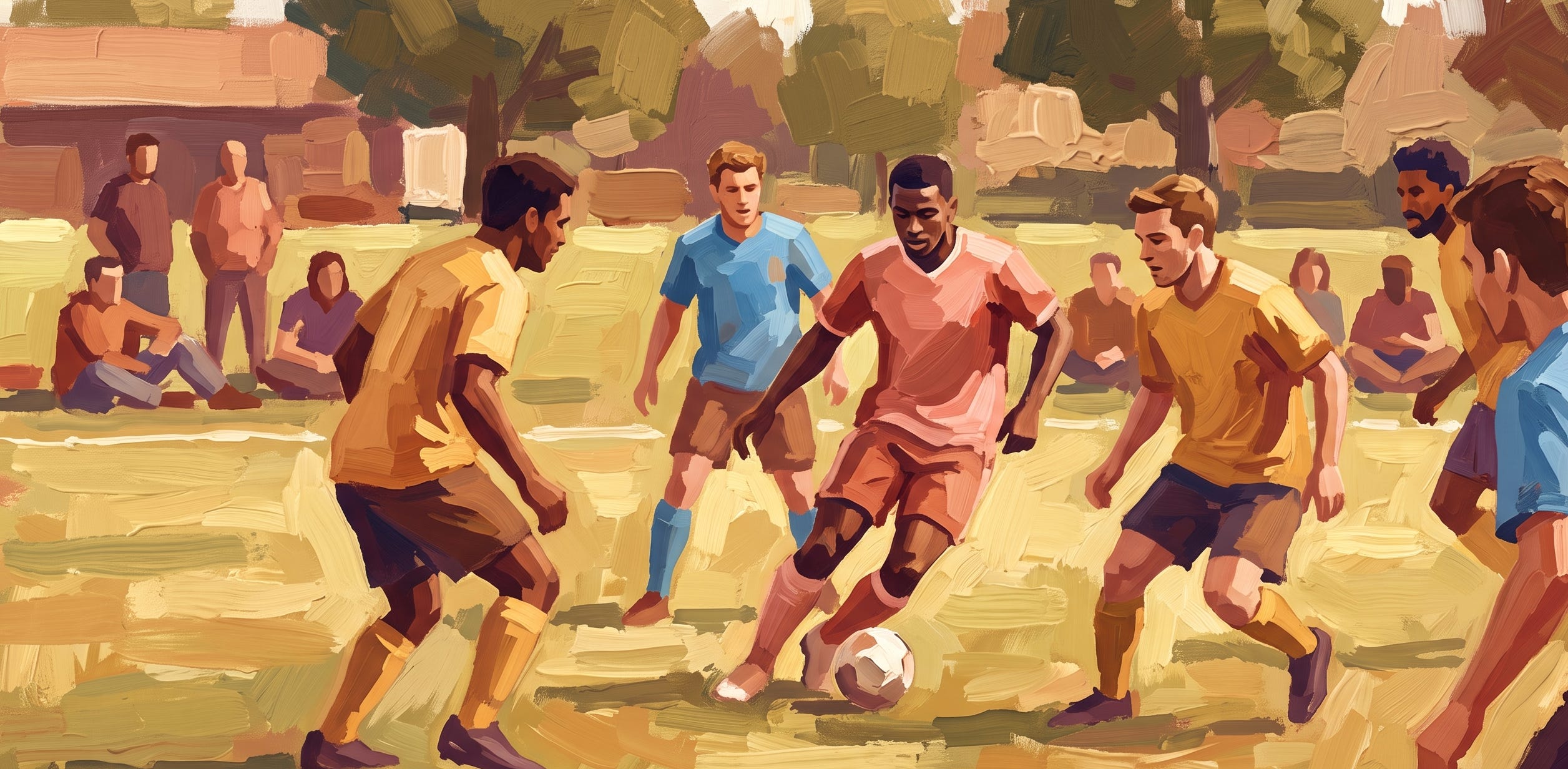
The World Cup connected the people of the world and the Trump Administration objected
For a month, international fans filled American cities and did something a lot of Americans didn’t expect: they were warm to us. Not to the government, to us. For people who’ve spent years wincing at how this country reads from the outside, the distinction that we are not the people who speak for us landed like a gift. The Ringer called the tournament “a distinctly American contradiction,” and that was the good half of the contradiction.
Then the bad half showed up. After Folarin Balogun’s red card against Bosnia, President Trump leaned on Gianni Infantino to make the suspension disappear. As a reminder, Infantino handed Trump the first (totally not made up), “FIFA Peace Prize” last year.
By rule, a red card suspension cannot be appeal under any circumstance. In this case? FIFA obliged. No suspension. The backlash was instant and global: the EU’s sport commissioner said sporting decisions belong to sporting bodies, Belgium’s coach compared it to an April Fool’s joke, and the US went out anyway. Plenty of American fans blamed the intervention for poisoning the run.
The call was probably wrong and that’s not the point. The point is that soccer fans from around the world has spent weeks separating the American people from it’s poorly viewed government. An in a flash, Trump reinserted himself, on camera, to fix a soccer suspension.
Netflix didn’t rent the AI tools. It bought the toolshed
Netflix’s SEC filing confirmed the number this month: $587 million in cash for InterPositive, Ben Affleck’s 16-person AI startup that builds filmmaking tools from a production’s own dailies (relight a scene, adjust a performance, train a model that belongs to that film alone). All 16 people will go in-house at Netflix and Affleck becomes a senior adviser.
Put that next to the A24-Google deal from June and the difference is the story. Google invested roughly $75 million in A24 (its first equity stake in a Hollywood studio) for a research partnership: A24 filmmakers help DeepMind shape AI tools, but Google gets no library access and no training data, so A24 keeps creative control. A24’s pitch was “we’d rather have a seat at the table.”
Read the direction of ownership in each deal. Netflix, which already owns its pipe to 300 million households, spent nine figures to own the means of production too: the tools, the team, the models. A24, the most valuable brand in independent film, sold a piece of itself to a technology company for proximity to tools it may never own.
These are two very different types of investment. Netflix owns a kit and A24 owns a lease. A24 bought a relationship with the company who will control access to some of the most important tools in the world, but Netflix (as they like to do) are looking to build their own premium room that only they have access to.
The Emmys cut the writers, of all people, this year of all years
The Television Academy voted to pull five categories off the September 14 NBC telecast: variety writing, limited-series writing, limited-series directing, and both limited-series supporting acting awards. The main show drops to 19 awards to make room for sketches and longer speeches. The DGA, WGA, and SAG-AFTRA issued a rare joint statement calling it a devaluation of the people the Academy exists to honor.
Is it good for fans? Honestly, mostly yes. A tighter three-hour show with fewer walk-ups is a better television product, and the casual viewer won’t miss the writing categories. And that’s the uncomfortable part.
Is it good for the industry? No, and the timing is the tell. The same summer studios started spending hundreds of millions to own AI production tools, television’s own academy decided some writers and directors are the part of the broadcast the audience can skip. These categories were demoted to commodities just like the scientific awards that happen elsewhere, on a different day.
Each decision is defensible alone. All together, it’s a message about whose work the industry considers optional.
We’re still standing
Here’s the pattern, because these five stories are one story.
The edges of culture keep opening: 48 teams, 525,000 Cape Verdeans with a knockout-round side, a month of strangers being kind to Americans in American stadiums.
And the center keeps closing: a chip that decides goals by the millimeter, a president who can vacate a red card with a phone call, a streamer that now owns the cameras and the tools behind them, an academy trimming the credits to fit the ad breaks.
Access is getting wider while control gets narrower. The control is happening quietly because the access makes such good television. As Neil Postman wrote about in ‘Amusing Ourselves to Death,’ it’s looking like Aldous Huxley was onto something with his view expressed in ‘A Brave New World,’ where the people of the world are oppressed by their own addiction to amusement.
The World Cup gave us the best month of sports in years and a stark reminder that it’s all still a show, controlled by a few men sitting in a luxury box.
— Will, Steph, & Jamie
What we’re watching
Sept 5-6: Emmys ceremonies (the five relocated categories land here)
Sept 14: Emmys main telecast, NBC/Peacock, 8pm ET
Early 2027: IFAB’s annual meeting, where the offside-law fight gets formal (date not yet announced)
A question for you: What’s the one 2026 World Cup moment you’ll still be telling people about in 2030?