


What we carried this week
This week, we found ourselves thinking about value: what we pay, what we surrender and what we mistakenly treat as proof.
Polaroid is betting that our increasingly digital lives have made analog memories more valuable. LeBron is betting that one more championship could be worth far more than another maximum contract. Prediction markets are betting that enough money can reveal the truth—even when the person at the center of the story hasn’t made up his mind.
And in Hollywood, one of the biggest proposed deals in the industry is testing what happens when money that once looked limitless starts encountering limits.
Our recent work
What do voters actually get?
Jamie is back again to argue that Democrats need more than anti-Trump messaging. They need to prove how voters’ lives will actually improve.
Serena Williams’ Wimbledon comeback and ESPN’s paywall
Jamie reflects on Serena Williams’ 2026 Wimbledon return, the wild-card debate and ESPN’s subscription model for watching every match.
Polaroid’s Analog Summer
The new campaign to sell an analog Polaroid Go camera swept Will off his feet.
In case you didn’t know, Gen Z and Gen Alpha are showing signs of rejecting a fully connected digital life. As someone who daydreams about throwing out my smartphone and going back to a Nokia brick, I’m 100% on board.
The campaign is pretty simple: a broad white billboard with a Polaroid photo in the middle that looks like it was lazily tossed onto a table. Each one includes a handwritten tagline reflecting what we’re seeing:
“Remember that night we spent on our phones? Me neither.”
“Go jump in some water before the data centers drink it all up.”
“How much of your camera roll do you really remember?”
Don Draper would be impressed. It cuts deep, and it’s been stuck in my head since I first saw it. Perhaps that Nokia is in my near future.
—W
I encourage you to go check it out yourself. Here are a couple of links to check it out:
From the Culturist (they have many good examples).

LeBron, the Sixers and the $8 million bet
There is absolutely an arbitrage story inside LeBron James accepting a two-year, roughly $8 million deal with Philadelphia after earning approximately $53 million with the Lakers.
The Sixers acquire one of the most commercially valuable athletes in the world at a fraction of his market value. Ticket prices rise, attention follows and the value LeBron creates will extend far beyond what Philadelphia is paying him. Much of the money he left behind won’t be redistributed to his teammates. The owners will capture an enormous share of the upside.
That lopsided value transfer was identified by Will. But, Steph believes the story LeBron is telling himself is different and that may matter more than the financial math.
The NBA’s second-apron rules were created to make it prohibitively difficult for expensive teams to keep adding talent. Boston became the clearest example: even a championship-caliber core built around Jayson Tatum and Jaylen Brown became nearly impossible to maintain.
That disruption helped produce an extraordinary opening in Philadelphia. Brown joins Tyrese Maxey, Joel Embiid and promising second-year player VJ Edgecombe. LeBron doesn’t have to arrive as the player expected to carry a franchise through all 82 games. He can join a roster already built to absorb the regular-season workload and preserve him for the moments that could define his final chapter.
That changes the calculation.
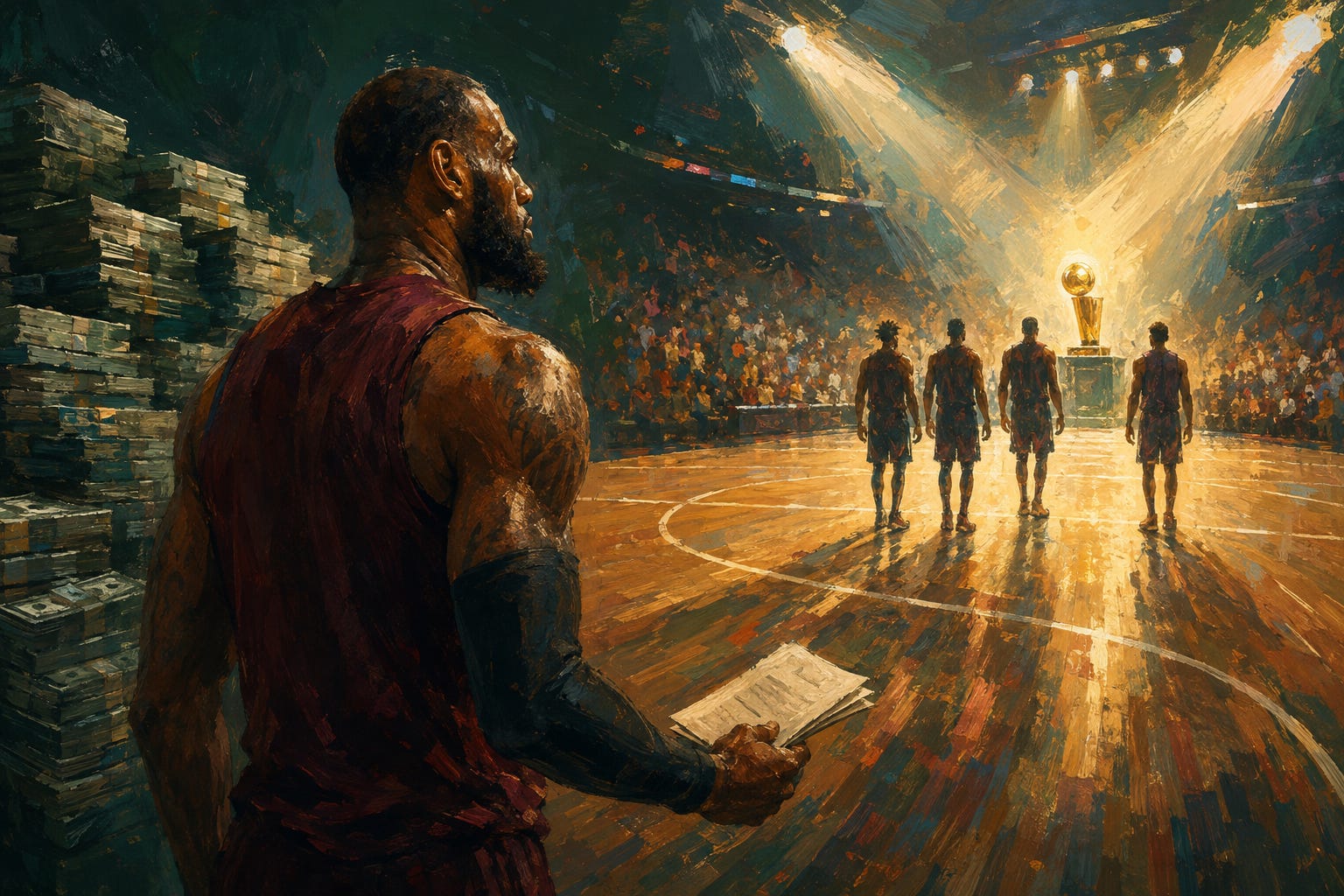
LeBron isn’t merely taking less money to chase another ring. He is wagering approximately $53 million on the possibility that another championship is worth more to his legacy than another year at his maximum salary.
If it works, the money will barely register as a loss. A championship in Philadelphia—late in his career, alongside a roster he chose and on financial terms only he could afford to accept—could redefine what the final stage of an elite athlete’s career looks like.
LeBron has already made more than enough money to protect himself for generations. What remains scarce is opportunity: the right team, the right timing, a body still capable of contributing and one more realistic path to a championship. Money can buy many things. It cannot purchase another healthy postseason three years from now.
The Sixers are getting an extraordinary bargain. LeBron is getting something valuable too: control over the ending.
The market that didn’t see him coming
Nearly $226 million moved through Kalshi’s “LeBron’s next destination” contract. Philadelphia remained a 1% long shot until July 1 and failed to break 10% until roughly 20 minutes before the deal was completed. Then it jumped from 9 cents to 99 cents almost instantly.
Markets like Kalshi trade based on rumors, conspiracies, speculation, and collective confidence. They can’t measure things like how LeBron valued money against legacy and the chance to author the ending of his career. All that capital failed to find the answer because the man with the answer may not have decided yet.
That failure reveals something to us alongside LeBron’s decision.
Kalshi isn’t a newsroom, but its numbers increasingly circulate like reporting. That’s dangerous. Markets do not create facts, only stories. They assign prices to what participants believe might become true. The price wasn’t insight. It was a mood with a decimal point attached.
The lesson isn’t that prediction markets are occasionally wrong. All markets are. We all need to remember that a percentage is not a verified source and millions of dollars moving through a market cannot reveal a decision that still belongs to a human being.
The hard data
LeBron accepted a two-year deal worth approximately $8 million, including a player option.
The contract represents a dramatic reduction from his approximately $53 million Lakers salary.
He described the move as his “last decision” after considering retirement.
Nearly $226 million moved through Kalshi’s market on his next destination.
Philadelphia remained a long shot until shortly before the decision became public.
Kalshi says its public charts use a smoothing algorithm, meaning the timing displayed may not precisely correspond with individual trades.
Sources
ESPN; LeBron chooses the 76ers on a two-year, $8 million contract
Front Office Sports — Prediction markets had no clue where LeBron was going
Legal Sports Report — The decision prediction markets did not see coming
Note: This analysis does not allege insider trading or misconduct by any individual trader. It examines what prediction-market pricing can and cannot tell us before a decision becomes fact.
The AGs might not be the undoing of the Paramount<>WBD merger
While the rules are bent to give billionaires cheat codes to do almost anything they want, at a certain point of stress anything can break.
Paramount is going to trial with 12 state attorneys general and the WGA. While we still believe the deal will ultimately go through, based on the historical precedent of similar deals and litigation, it is starting to look like an outlier for two significant reasons: debt and financing.
If Larry Ellison becomes the face of an AI bubble bursting, his personal backing of Paramount’s purchase of WBD could become very complicated. Oracle stock has been slipping, and the company recently laid off more than 20,000 employees, largely as it absorbs the cost of funding AI infrastructure.
Let’s unpack.
Larry’s personal guarantee is some version of equity financing. When someone holds a ga-gillion dollars in stock, let’s say Oracle, a bank may be willing to provide a loan with very, very little red tape. That’s because the bank can seize the stock through something resembling a margin call if the interest on the loan becomes too high or the value of the underlying shares falls below an acceptable level.
Putting it together
The Paramount–WBD timeline has been extended, and time always introduces additional risk.
Part of that extension includes a ticking fee, meaning the deal becomes more expensive the longer it takes to close.
A considerable portion of the money backing the transaction may be exposed to volatility.
Imagine trying to buy a house where the purchase price rises every day, the value of your down payment falls and the entire transaction is being delayed by 12 angry attorneys general.
Again, we still think the deal will end up going through largely because having Federal Approval pretty much guarantees the companies will get through any amount of litigation. But, it’s always about the money and with an AI bubble looming and nay-sayers getting louder; it could get very interesting.
Disclosure: Steph and Will are employed by WBD. Nothing written here comes from company knowledge. Our analysis relies on public reporting, court dockets, filings and general knowledge.

Until next week,
Jamie Renell, Will, and Steph