


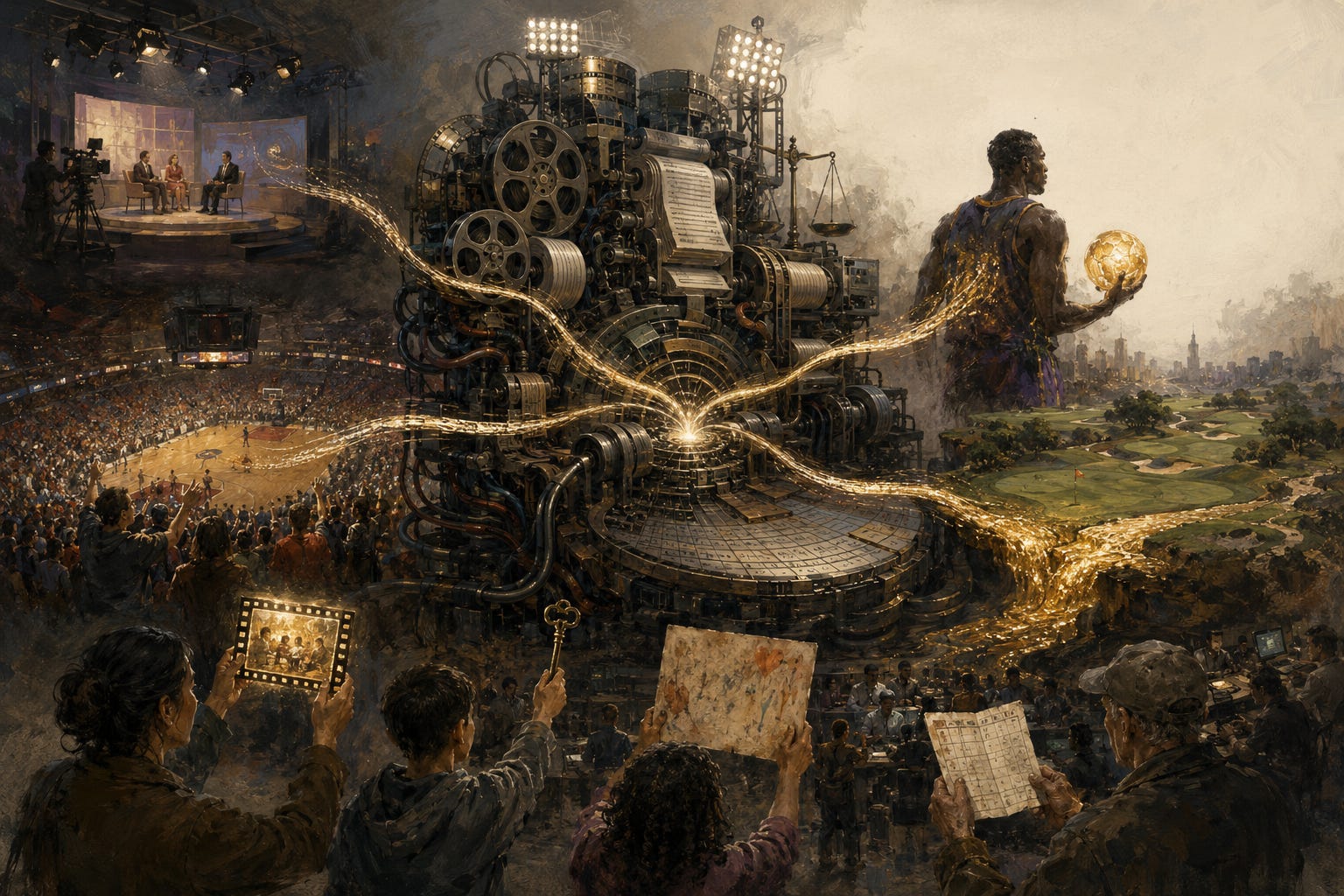
This week we pick apart the the weight of the machine and how the system always extracts it’s value, at any cost. Individuals will always pay. Once all the value has been extracted, a persons’s legacy is what’s left to fight over.
1. Hollywood extracted everything from Hayden Panettiere.

Hayden Panettiere passed away, and the immediate reaction was a scramble to make sense of a complicated life. Underneath the sensationalism is a story about the sheer, grinding labor of a working actor before the streaming era. As we came together to discuss her as a team, we were initially surprised by how much Hayden influenced people across all cultures. We all had completely different stories about how she had been in our lives and those in our communities. As we unpacked it more, it became obvious why this was the case. This woman was the rare combination of extremely good, and extremely prolific.
Steph spent a sad day pouring over Guiding Light clips and Remember the Titans scenes with her cousins. As her cousin Crittie put it: “That girl carried me on her back in the movie room with that Amanda Knox Lifetime movie.” This is Panettiere’s legacy. Not just a common celebrity; she was an industrial workhorse capable of carrying people she never met through their lowest times. She gave everything she had to the machine.
That legacy is already pulling audiences back. Heroes and Nashville are both seeing massive spikes in viewership since the news broke, climbing Netflix’s trending charts, while Remember the Titans does the same on Hulu and Disney+. People are seeking out the work because the work is what mattered.
We easily forget what television demands, especially in an era before streaming. Prior to eight-episode prestige seasons, daytime soaps and network dramas required relentless, soul-crushing volume. Panettiere could cry on command because she had to. She changed daytime television. She carried entire networks on her back. When you look at the sheer amount of media she produced, you realize she was operating in a factory system that extracted every ounce of her talent and energy.
There’s a secondary conversation here about post-partum depression, something Will discussed this week with his trainer, whose partner recently had a child. It’s not a topic most fathers ever bring up, and this was the week Will decided to change that to give some version of honor to Hayden. We treat these struggles as celebrity spectacles instead of human realities. The machine prefers a spectacle because it’s easier to consume. But the truth is much warmer, and much harder to look at. We owe her the dignity of honoring her labor, not just the tragedy of her passing.
The industry builds titans, and then watches them fall. Both are means for extracting value. When a child star with a massive catalog and messy management passes, the estate becomes the final battleground. The legacy is locked behind legal filings and management disputes. The labor is done, but the extraction continues.
Further reading: Variety on Panettiere’s legacy · The Hollywood Reporter on estate management · Netflix on trending charts
2. The era of family-owned sports is dead.

Jeanie Buss is fighting a war she might not be able to win. The latest reporting exposes a brutal discrepancy between the Buss Family Trust and the contract signed during the last Lakers sale. Five of her siblings have voted to sell the family’s remaining 17.8% minority stake to incoming owners Bob Iger and Joshua Kushner, a move that would drop Jeanie’s personal equity below the NBA’s 15% threshold required to remain the team’s governor. She is blocking the sale, citing a 2017 court order demanding the trustees protect her controlling position. The Trust, supposedly has the final word.
Will’s question here: what does “winning” even look like for Jeanie at this point? She is dying on a hill to protect a family legacy in a league that is actively breaking up with family and single-person driven ownership. If Jeanie Buss goes down fighting for control of the Lakers, dragging her siblings through court while the Iger-Kushner group waits in the wings, does she die a hero to the fans protecting the franchise’s soul? Or is she just a roadblock to the franchise’s inevitable corporate modernization? Maybe dying on the hill is the only victory left when the machine comes for your family business.
The Lakers are the most valuable and storied brand in the NBA, but they are operating on an antiquated model. Look at the modern ownership landscape. It is dominated by private equity, sovereign wealth, and mega-corporate buyers. The Buss family is a relic of a bygone era when sports teams were local family businesses rather than global media conglomerates. Mark Walter bought a controlling stake for a reported $12.5 billion, and now the corporate capital is coming for the scraps. A family trust, no matter how ironclad the 2017 court orders seem, cannot indefinitely compete with that kind of financial gravity.
The most likely resolution is a negotiated exit. The lawyers will bill millions, the court will weigh the fiduciary duty to maximize the trust’s value against the mandate to protect Jeanie’s governorship, and eventually, a settlement will be reached. Jeanie might walk away with a massive payout and a ceremonial title, but the era of Buss family control will end. The boardroom drama isn’t a business negotiation; it’s a desperate attempt to hold back the ocean.
Further reading: ESPN on the Buss Family Trust · Forbes on NBA franchise valuations · Sports Business Journal on the Lakers sale
3. Bob Iger, the NBA, and how he might leverage Luka Dončić.

Luka Dončić is carrying an entire franchise on his back. But the real story isn’t about whether he has enough help on the court. It’s about what his presence on the Lakers represents for the future of Bob Iger’s media distribution.
How many star players have ever been in this situation? And more importantly, is Bob Iger going to use Luka as a lever for international storytelling with the Lakers? When you combine the most popular international basketball player with the most recognizable sports brand in the world, you don’t just get a basketball team. You get a content engine.
Luka isn’t just a basketball player; he is a distribution lever. Bob Iger isn’t looking at Luka’s true shooting percentage; he’s looking at his ability to anchor documentaries, cross-promotional properties, and original programming across Disney’s global platforms. Iger doesn’t just want to broadcast the games. He wants to own the narrative architecture surrounding the biggest international star in the league.
This is the labor economics of the solitary superstar. The league and its corporate partners monetize the individual burden. Can Luka carry that whole team to a championship? Probably not, and sadly Austin Reaves probably isn’t enough help. But from a structural standpoint, the Lakers’ corporate ownership doesn’t strictly need Luka to win a championship right now. They need him to be the face of stories that open doors in markets they intend to dominate.
The superstar is the wedge. The media conglomerate is the hammer. The international audience is the nail.
Further reading: The Athletic on the Mavericks’ roster construction · [Front Office Sports on NBA international strategy · Bloomberg on Disney’s global sports media rights
4. One more ridiculous number
LIV Golf spent billions of dollars to go broke on purpose.
Read that again.

They fractured the sport of professional golf, handed out astronomical contracts, and are reportedly out of money. And somehow, there is still a path forward. Why? Because maybe, this was never about building a golf business.
This is the Sovereign Wealth thesis in action. A sovereign wealth fund is essentially a state-owned investment fund designed to protect and grow a nation’s wealth, but at a certain scale, the goal shifts from pure financial return to global influence. LIV Golf is just might be a geopolitical loss leader, a branding exercise decoupled from the profit-and-loss mechanics of a traditional sports business. When a nation-state decides to launder its reputation or assert its presence on the global stage, sports provide the cheapest, most effective cultural real estate available.
The PGA fought LIV as if they were a competing business, but failed to realize they were up against infinite, non-economic capital. When the ultimate goal is soft power and geopolitical influence, going broke on a golf league is just a rounding error on a much larger spreadsheet. This leads to another question for another time; Will wonders if fighting LIV golf will be good for the PGA in the end, or will that financial strain be their own undoing?
Further reading: Wall Street Journal on LIV Golf’s finances · Financial Times on Sovereign Wealth in sports
THE TAKEAWAY
The same thing can look like a legacy from above and a tragedy from below. The machine doesn’t care about your family trust, it doesn’t care about your international leagues, and it certainly doesn’t care how hard you worked in the movie room. It only cares about what it can extract next.
That’s the haul. See you next week.