


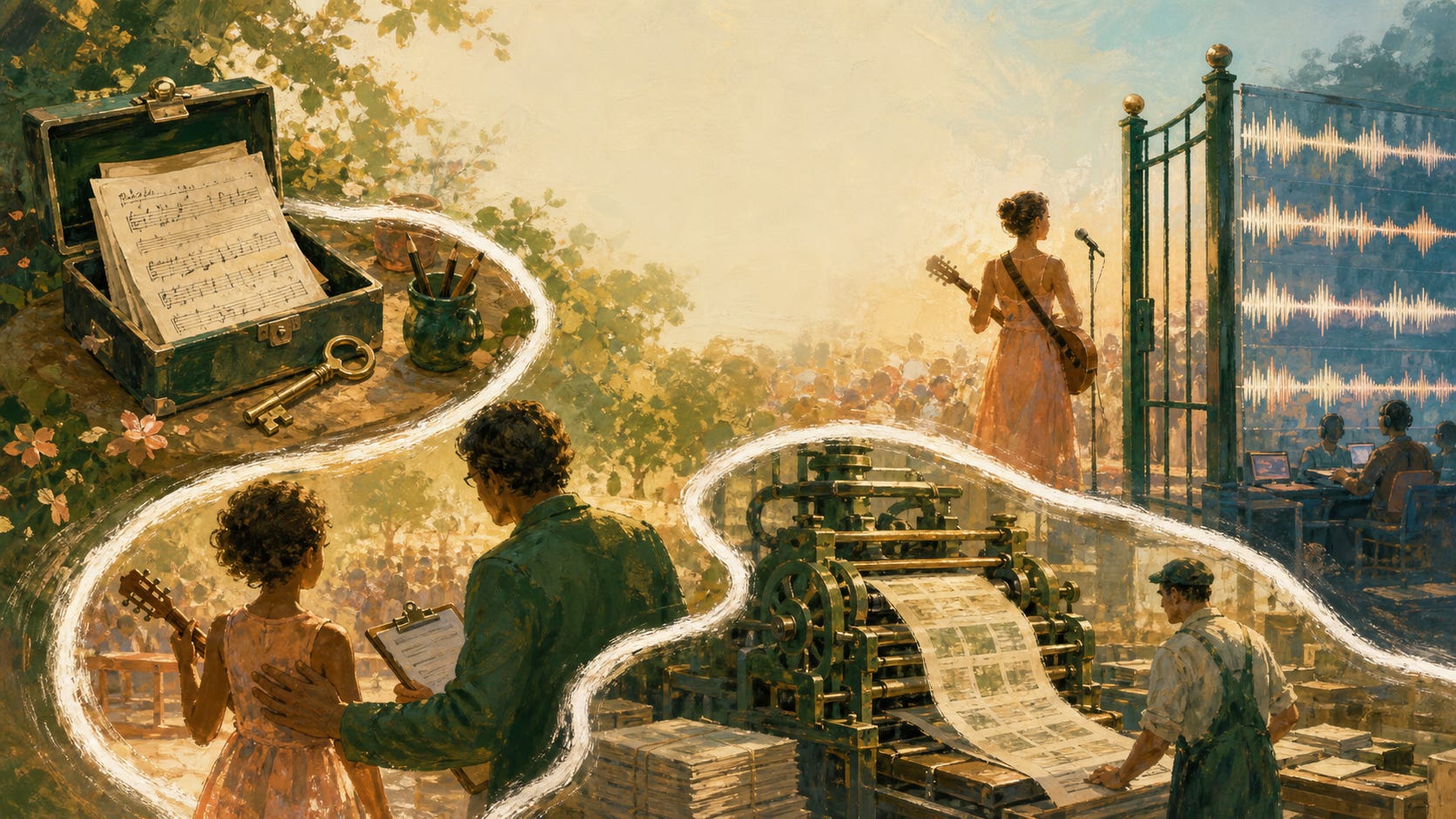
Four stories got seated together at the world’s most confusing wedding reception: Dolly Parton’s estate, Hayden Panettiere’s childhood, The Wall Street Journal getting comfortable with AI, and an Australian music chart attempting to define what a human contribution sounds like. Normal stuff. Very relaxing.
They all show us something about the distance between creating something and controlling what happens to it. A creator puts in the work. Another person or institution decides whether that work is protected, credible, eligible, or profitable.
Increasingly, being the person that creates something new is not where the power lives. The power lives with whoever can label it, distribute it, inherit it, certify it, or send a strongly worded email saying it’s actually theirs. The creator builds. Everybody else files in with ledgers and paperwork.
Dolly Parton: Ownership Was the Protection
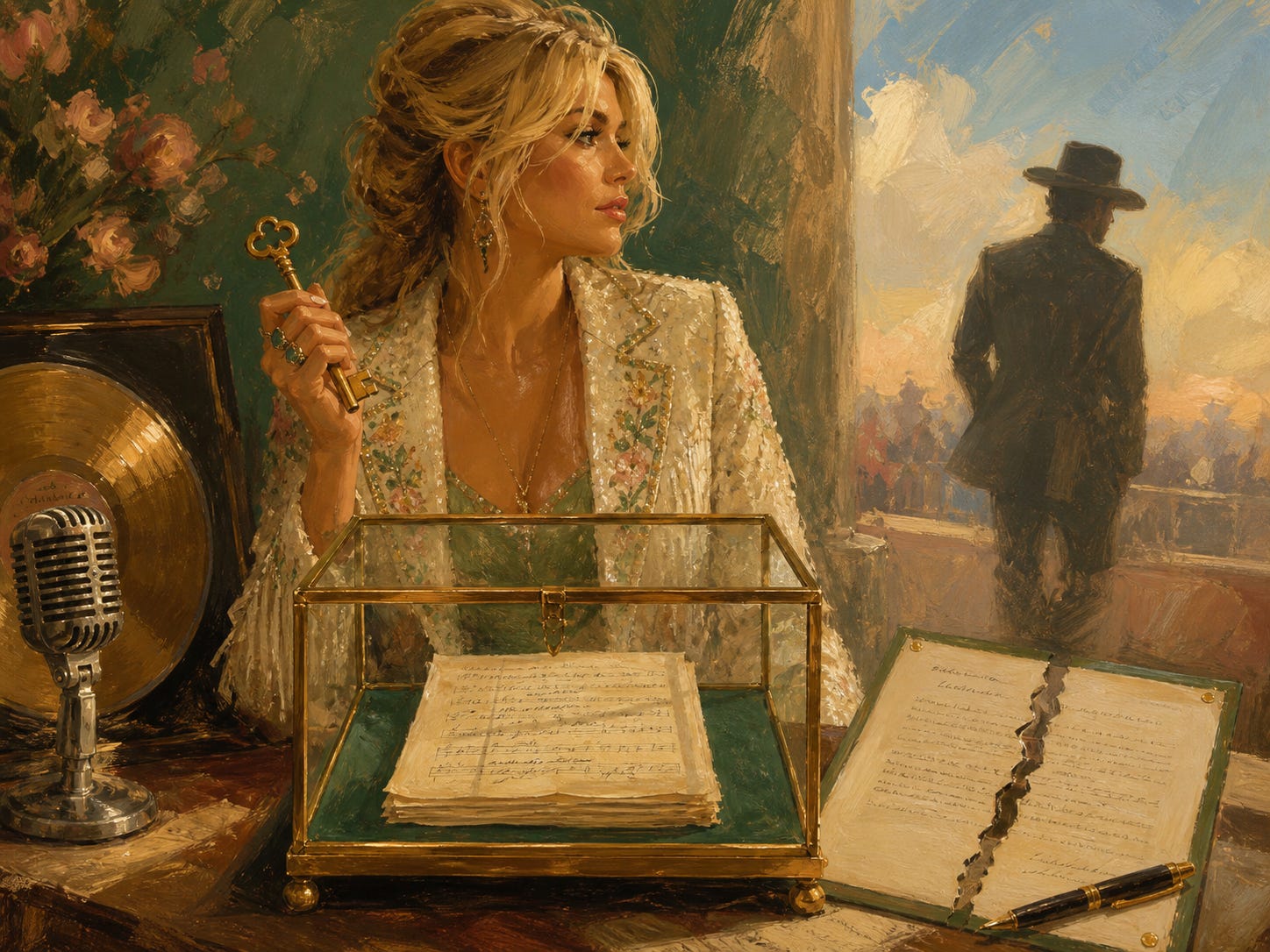
Dolly Parton understood something many artists learn approximately six contracts too late: applause is lovely, but ownership is lovelier. Just ask anyone who’s won American Idol. Applause cannot be transferred to your heirs. Publishing can.
When Elvis Presley asked to record “I Will Always Love You,” Dolly was excited. Then Colonel Tom Parker told her that Elvis’s team expected at least half of the publishing. Not half the revenue; half the ownership of her song.
Dolly did not reject Elvis. She rejected the idea that access to Elvis was worth surrendering control of her work. The offer was essentially this: give us half of the thing you created and, in exchange, a more powerful man will make it famous for you.
She said no. And eventually, Whiney Houston recorded her cover of the song, all while Dolly retaining ownership. 2 women working together to make one of the most iconic recordings in all of history.
That is less a story about resisting celebrity than recognizing a bad contract even when it arrives wearing rhinestones. A LOT of rhinestones.
The decision matters far beyond just one recording. Dolly kept her publishing rights, and with that she retained the authority to decide what could happen to the song, and who could benefit for it. Her ownership was a form of protection that outlasted any single performance, deal, or gatekeeper.
Dolly understood that ownership is what allows a creator to remain in the room after everyone else arrives with plans for the creation.
Dolly had the experience and leverage to draw that line herself. Child performers often begin working before they can understand the line, much less negotiate who gets to draw it.
Sources: PBS on Dolly’s publishing decision · Los Angeles Times on the Elvis deal
Hayden Panettiere: When the Protector Is Also on Payroll

The entertainment industry has rules for child performers: limits on working hours, school requirements, and laws governing where the money goes. The rules are concerned with the child’s schedule and paycheck. But what about the actual living, breathing child?
There’s a strange bargain at the center of child stardom. The industry says a child must be protected by an adult. Almost always, that adult is someone whose household income, identity, access, or professional authority may depends on that child’s work.
Hayden Panettiere’s mother managed her career from infancy. Hayden later described realizing that her mother was not just her mom; she was also her boss. A parent can say, “You don’t have to do this, I love you just the way you are, let’s go home and have ice cream.” A boss, historically, has a different vibe.
Detailing her Panettieres’ relationship with the ‘Child Star Bargain’ does NOT require turning Hayden’s mother into a villain. That framing is far too easy, and it lets the industry off the hook. A parent can still love a child fiercely while operating in an industry where protecting the child may mean stopping the work, and stopping the work may threaten the family’s stability.
The system did not fail because a mother became a manager. It failed because it treated a financially interested manager as an independent safeguard simply because she was also a mother.
The industry placed “mother,” “manager,” “boss,” and “protector” inside the same person and hoped those jobs would never disagree. This is why conflicts of interest are so important to pay attention to. Protecting a child means that their guardian needs to have clear enough eyes to stop the child from working more when they’re in danger. When your financially invested in the outcome, you can’t make that decision cleanly. Management means keeping it going. When a child’s success becomes the family business, care and commerce are forced to share an office.
In Hayden’s story, the word “parent” was treated as proof of protection. In the next story, a famous name is treated as proof of authorship. In both cases, the label is allowed to substitute for the process.
Source: Hayden Panettiere on becoming a child star
The Wall Street Journal: When the Name Becomes the Product
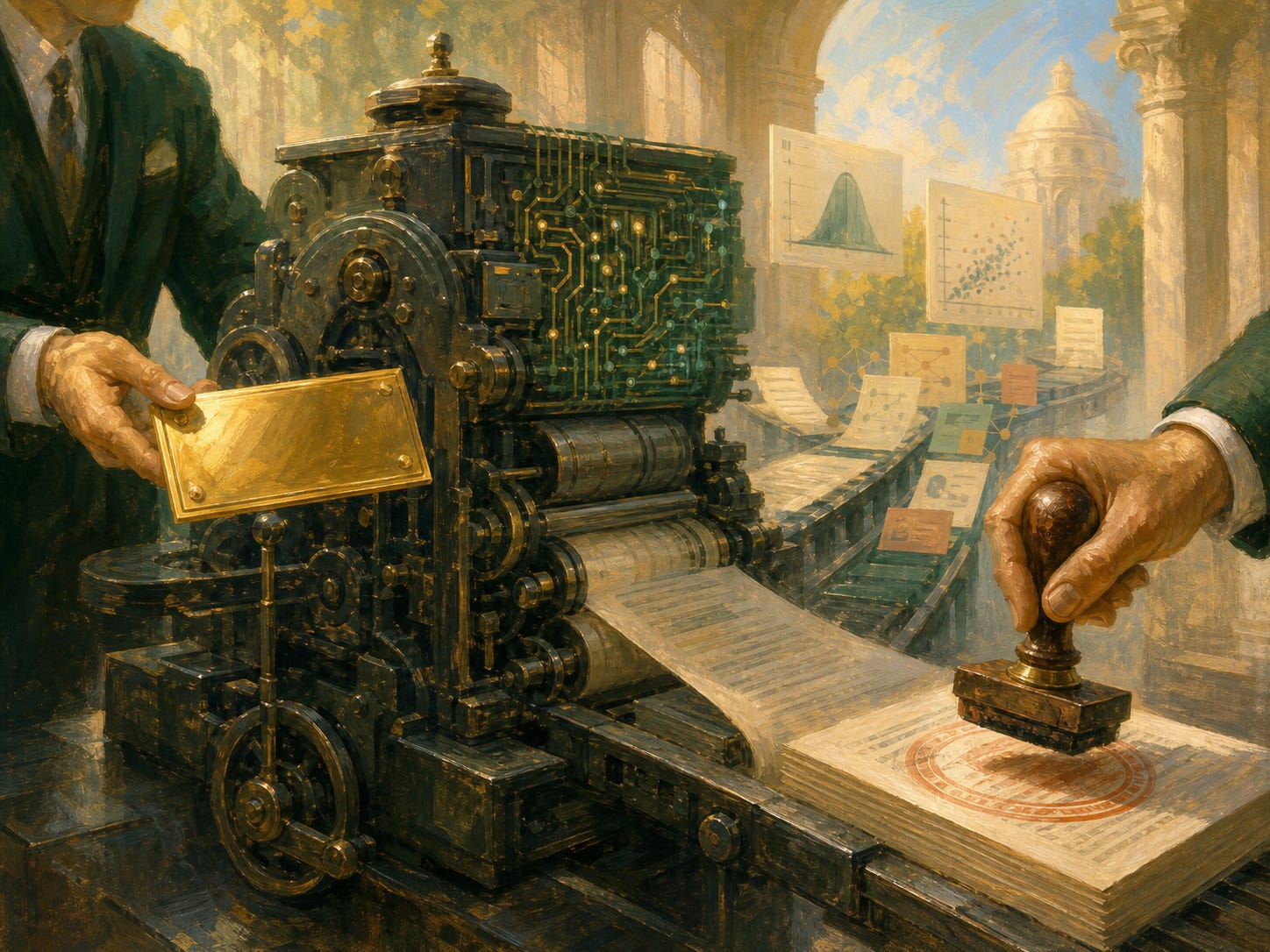
The Wall Street Journal landed on a fascinating new definition of authorship: employees have to write, but billionaires merely have to agree.
Stanley Druckenmiller acknowledged using AI to produce an opinion piece for the WSJ, and the Journal defended publishing it without disclosure. The Journal’s reasoning was that the argument reflected Druckenmiller’s views and that he had the standing and credibility to make it.
Which is an incredible policy when you say it slowly.
The Journal’s own opinion writers are expected to write their columns by hand (well, computer). But an outside contributor who was invited precisely because his name carries authority, can outsource the writing to a machine. He supplied a position (we assume). The chatbot supplied the sentences. The Journal supplied the credibility. Everybody contributed something except, apparently, an author.
The issue is not whether AI can be a writing tool. Our question is, “can a byline still tell readers who produced the argument they are being asked to trust?” Adding a disclosure does not forbid the tool; it gives the audience enough information to know where responsibility sits.
Instead, authorship becomes flexible according to status. Staff writers must satisfy a traditional standard. A sufficiently powerful contributor can arrive with a verified opinion in whatever packaging is convenient. The famous name does the work; the writing is just window dressing.
That is the larger story: institutions are separating credibility from creation. The contributor does not necessarily have to write the article. He needs enough authority for the institution to certify that the machine-written article represents him.
Polymarket’s involvement makes the pattern harder to dismiss as a one-off unusual op-ed. A Columbia Journalism Review analysis found fabricated stories and nonexistent citations in Polymarket’s platform’s AI-generated news timelines. In short, Polymarket is feeding AI generated (and hallucinated) news to its users who are betting with real money, on the outcomes to real world events. Dow Jones, the Journal’s parent company, has partnered with Polymarket to put its probabilities into Journal and Barron’s products → Read this paragraph again.
The same ecosystem is making two related bets: a respected person can lend authority to machine-produced writing, and a respected publication can lend authority to machine-produced information.
The product is not the writing. It is not even the information. The product is permission to believe it.
Sources: The Atlantic on the Journal’s AI standard · Axios on Druckenmiller’s disclosure · Columbia Journalism Review on Polymarket
ARIA and TikTok: Who Decides What Popularity Counts?
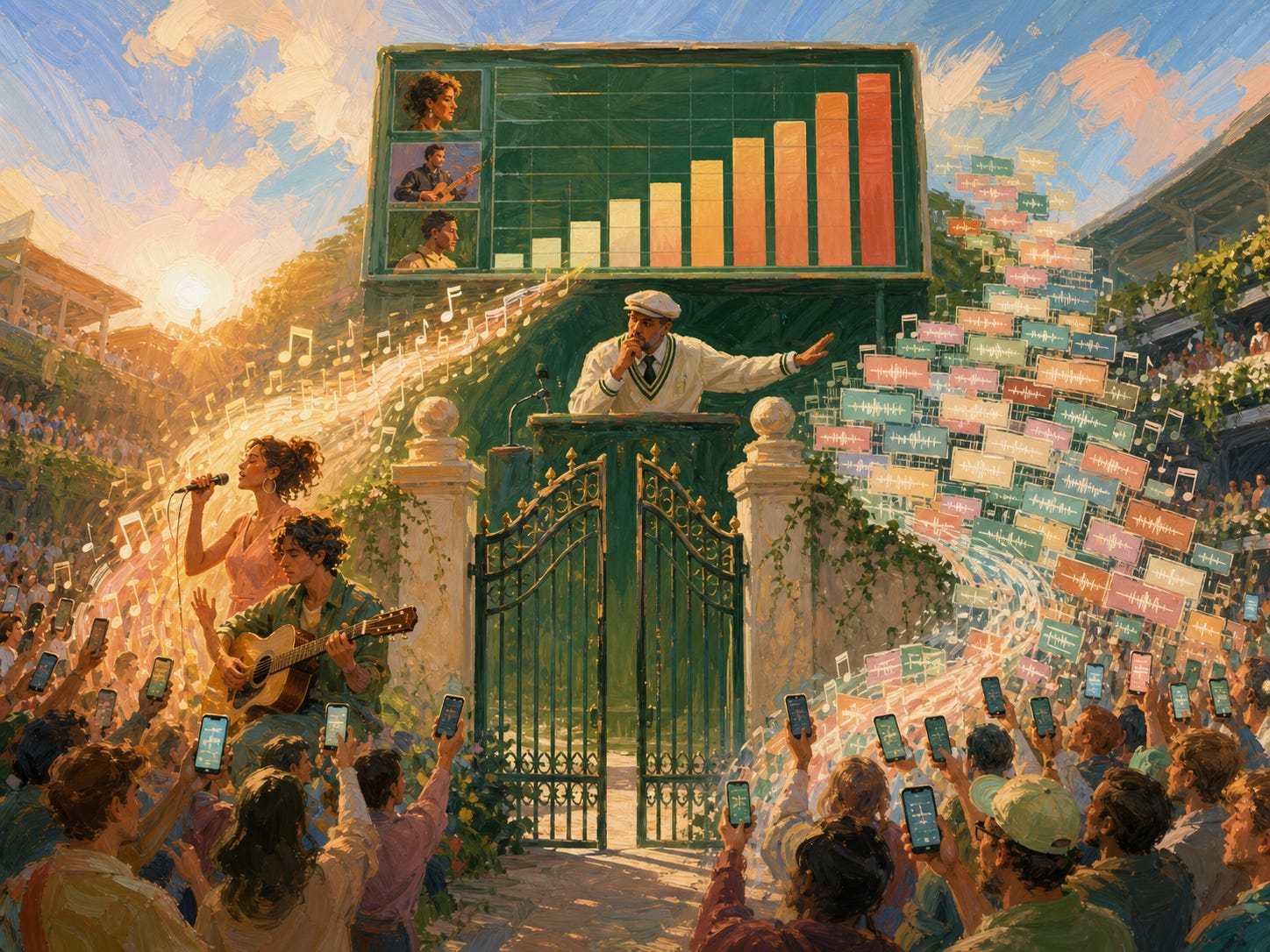
ARIA’s new rule has been described as a ban on AI-generated music, but the more consequential change is what it says about the purpose of a chart and about the kind of music platforms now reward.
TikTok had already changed what a successful song needed to be. A recording did not always need a patient musical build up, a memorable second verse, or even a complete identity. It needed a fragment that could survive outside the song: a hook people could dance to, joke over, speed up, slow down, or reuse in millions of unrelated videos.
That changed the unit of competition. Artists were no longer competing only to make the best recording. They’re competing to provide the most reusable snippet of audio.
TikTok did not invent commercial pressure in music, and it is not solely responsible for what reaches the charts. But it tightened the relationship between platform behavior and chart success: a sound performs well in short-form video, the attention travels to streaming services, and the streams move the song onto an official chart.
Generative AI takes that system to its logical extreme. If an algorithm rewards a particular mood, hook, or tempo, AI tools can produce endless variations without the time, expense, unpredictability, or labor involved in developing a human artist. Music risks becoming algorithmic inventory: cheap to generate, easy to test, and disposable when the trend changes.
ARIA is trying to place a human boundary inside that system. Its rules allow some AI-assisted recordings when the central creative work remains substantially human, while excluding tracks whose lead vocal or other key components are generated by AI.
That may be a defensible way to protect artists and recorded-music labor, but it also changes ARIA’s role. A chart is supposed to answer what people are listening to. ARIA is now asking a second question before it counts that listening: was this recording made in a way we recognize as legitimate?
The phrase “substantially human-made” still leaves enforcement questions. Who proves who wrote, sang, or performed a part? And will independent artists using inexpensive tools face more scrutiny than major labels with lawyers, documentation, and established production systems?
The most revealing contradiction is that ARIA distributes and promotes its charts through TikTok. It depends on the platform-driven attention system while reserving the authority to reject some of that system’s most successful outputs.
TikTok helps decide what becomes popular. ARIA decides whether that popularity counts.
ARIA is not creating the demand, just as the Journal is not creating Druckenmiller’s ideas. Both institutions control the certificate attached afterward: credible, eligible, real. Once a chart decides which creative processes deserve to be measured, it stops being only a mirror of taste. It becomes cultural and labor policy—written by the organization holding the scoreboard.
Sources: ARIA’s chart eligibility FAQ · IFPI’s global AI chart principles · TikTok and Luminate’s Music Impact Report
The Line Is the Power
These stories look different because the people holding the authority wear different outfits: an estate representative, a parent-manager, an editor, a chart organization. One has a publishing contract, one has a call sheet, one has a masthead, and one probably has a very detailed PDF about eligible vocal tracks.
But each controls a boundary.
Dolly’s ownership determines who can use her work. The parent-protector determines when a child is safe enough to keep working. The publication and byline determine what readers are asked to trust. ARIA determines what music is sufficiently human to compete.
The problem is not that boundaries exist. Children need protection. Readers need standards. Charts need rules. Artists need ownership. The problem begins when the person drawing the line benefits from where the line is placed—and when the label on that person’s role is treated as proof that the decision is trustworthy.
Making the thing may be easier than ever. What remains scarce is the authority to say what is protected, what is credible, what is human, and what counts. That is where the power lives now—not only in creation, but in deciding what creation is allowed to become.
-Steph, Jamie, & Will