

Just like the “Mother,” How I Met Your Mother is dead to me. It was once my favorite show on TV and it was back in a time when you could miss an episode (and I never did). It was Friends for my generation and I connected with it deeply. Now I can’t stomach a single episode because it all ended so badly.
This isn’t the first time this has happened, and I’m sure it won’t be the last. I have an uncomfortable physical reaction when I see shows that are now dead to me. So I got curious - why on earth does this happen? Why can’t I just go back and enjoy seasons 1 through 6, blissfully ignore the ending all while convincing myself that the show was simply cancelled by some network goons?
Unlikely inspiration from an awful vacation
My eyes were opened on a beach trip. Six days of perfect weather, incredible meals, and lazy mornings. It was supreme relaxation. Then the last day: my wife and I got food poisoning, nearly missed our flight, my luggage with my favorite bathing suit was lost, and we were swapped out of our bulkhead seats (that we specifically paid extra for) in order to accommodate what I can only describe as the most Karen who ever Karen’d. When people asked “how was the trip?” I said “disaster.”
Pure bliss for six days. Miserable for six hours. In the end, all I remember are those six hours.
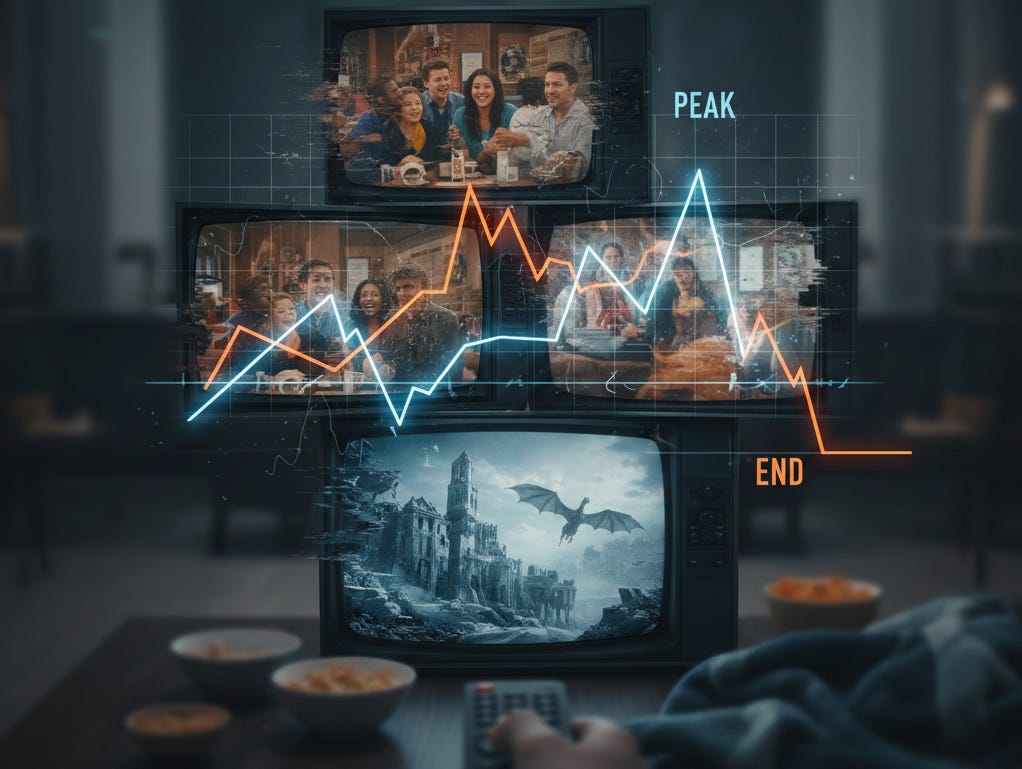
That’s the Peak-End Rule. In short, some really smart behavioral economists including, but not limited to, Barbara Fredrickson, Daniel Kahneman, Charles Schreiber, Donald Redelmeier, and Amos Tversky figured out that human memory doesn’t encode experiences based on duration or average quality. Instead, we remember two things: the most intense moment (the peak) and the final moment (the end). Everything else fades.
That means you will remember a long and terrible experience that ends on a bright note more fondly than something that was mediocre all the way through. Even worse; you’ll remember a bad experience with a nice ending more favorably than a good experience with a terrible ending.
That may seem complicated, but it’s like getting stuck in horrible traffic on the way home from a lovely dinner. You get home in a bad mood. All those dad’s wanting to leave in the 7th inning to beat traffic knew what they were doing.
Now my wife and I obsess over our trips home. We’ll pay for upgrades, add buffer time, and anything to protect the ending. Because we know: the trip home is still part of the vacation. Like most scientifically proven principles, it’s happening to you whether you understand it or not. But once you see it, you can’t unsee it.
The HIMYM Betrayal
How I Met Your Mother and Friends had the same DNA (spoiler alert: most sitcoms do). A group of friends and close acquaintances in early-to-mid adulthood either live together or nearby each other. They somehow manage to have coffee or breakfast with each other every single day. Some of them date within the friend group, some outside. Eventually it becomes clear that 2 of the friends are deeply in love, they date, there’s at least 1 terrible break up, they date other people, then come back together and hooray - some version of happy ending.
Friends is still comfort food. How I Met Your Mother is entirely unwatchable for me. And let me be clear - I’m not trying to convince you to feel this way too. If you love that show, then please god enjoy it for both of us because I miss it, but I just can’t.
Here’s what I saw: HIMYM created a phantom character (the Mother) that drove unbounded mystery. You knew her, but you didn’t. You weren’t just watching the discovery, you felt like you were part of it. Then the finale weaponized your investment by revealing Ted never really let go of Robin.
Imagine if Friends ended like this:
Ross doesn’t really get with Rachel in the early seasons. He’s constantly chasing Emily instead.
Then suddenly in the final season - BAM - Rachel appears, they build a life together in about 2 episodes, fast forward a few more episodes and they’re married, have a 2 kids, and she dies.
And THEN Ross ends up back with Emily because he actually loved her all along.
It’s ludicrous and I hate that I just wrote that out.

That’s what HIMYM did. The finale didn’t just disappoint, it retroactively erased the meaning of every episode where Ted moved on from Robin. He’s telling a story to HIS CHILDREN (who just lost their mother) about how he loved their fake aunt the ENTIRE TIME. Nine seasons of narrative and trust, obliterated at the finish line. Peak-End Rule took a show I loved and corrupted every memory I had of it.
The Game of Peaks
Let’s look at another famous flame-out: Game of Thrones was one of the best TV shows ever written... until it really wasn’t.
My wife and I did a rewatch out of morbid curiosity during the Pandemic and discovered something interesting: knowing Daenerys goes crazy in the end feels obvious when you see how psychotic she is the whole time. The problem wasn’t the destination. The entire approach to storytelling changed and it fumbled everything.
Early Game of Thrones: all the characters are villains, some worse than others. You found yourself siding with evil people doing terrifying things to other people you hated just ever-so-slightly more. The show trained you that consequences matter, politics are complex, and anyone can die. They respected your intelligence.
Later Game of Thrones: a classic hero’s tale of good versus evil where mystical prophecies matter more than anything else, and the main characters have plot armor. It became a Disney movie and they treated you as though you were a child.
The finale abandoned the show’s own rules.
GoT is a great example of when Peak-End Rule gets vicious. Those early emotional peaks (the Red Wedding, Ned’s execution, “You know nothing John Snow”) felt meaningful because of the rules the writers set out. When the ending proved the show didn’t actually believe its own stakes, those peaks collapsed. They went from earned to manipulative.
Contrast that with Succession. Logan’s death, Kendall’s rise and fall, and the final boardroom all felt logical and inevitable given everything we’d seen. Peak and end in perfect harmony. I can rewatch that show forever. You may not like the ending, but the show never abandons it’s principles.
Where it gets complicated
This whole thing got me thinking, and an unexpected connection appeared. I’ve started to notice certain people are making a comeback from being cancelled and it’s been really bothering. Many of them are genuinely terrible humans who appear to have don’t nothing to redeem themselves aside from waiting-it-out. Peak-end can help to explain why some people have been able to “uncancel” themselves.
Cancellation is a peak, but not always the end.
The public gets to decide when the story ends. If someone re-crafts a new “end” that reframes the emotional peaks of their cancellation, redemption becomes possible. That’s why immediate public apologies fail. They add emotional heat to the peak instead of creating a different ending. PLEASE NOTE: You still need to apologize for wronging people. Just make damn sure the apology matches the size of the offense.
Now we talk about Kanye. Multiple controversies, each one a new peak. But, can he craft an end that gives meaning and context to all of it? Personally, I don’t know. He might not be a great example, but he’s still out there doing Kanye stuff and who knows, maybe he’ll make a real comeback, everything will magically make sense, and we’ll all forgive him for selling Nazi t-shirts.
Peak-End rule can help you predict, and not just explain these sorts of things. You can evaluate comeback attempts through this lens: does the proposed ending have enough weight to reframe the emotional peak for me? It’s tricky to catch yourself and think through it when your emotions are running high, but you can ask yourself two things to reframe what’s happening.
How high was the peak? The more emotionally invested you are, the more weight the ending carries. This is why casual Game of Thrones viewers can still rewatch it, but super-fans can’t. They experienced higher peaks, so the bad ending hit harder.
What’s my moral threshold? Are you willing to accept or forgive? This is individual and non-judgmental based on your morals (yes you still have to have morals). Many people still listen to Kanye. Others can’t. Neither is wrong. Neither is right. You do you.
What You Can Always Rewatch
Knowing what you know now; what shows can you always return to?
For me, I have some easy picks right at the top of my mind: Schitt’s Creek, Succession, Frasier - these have consistent story telling with some small ebbs and flows, and they all end strong. The peaks and endings reinforce each other. They’re easy to love again and again.
Once you see Peak-End Rule operating in your life, you can’t gain the power to override it. Memory doesn’t work that way. But you gain something better: the ability to choose where you invest emotional attention and understand which memories you’re encoding in real-time.
I still can’t watch How I Met Your Mother. But, now when I’m 20 hours into a new show, I watch it differently. I protect my peaks by being selective about how the story telling unfolds. That’s the real power here. Choosing what gets encoded next.
Let me know in the comments what shows and movies you can always rewatch (and for those of you who have finished, will you be rewatching Stranger Things?). And you gotta give me the ones you despise now. I need to know I’m not alone in this.
Already started my Heated Rivalry rewatch, but we’ll see how it ages after what I hope will be many seasons. But mostly, I don’t rewatch favorite series because they lose some of their appeal once the experience is over - you go through something the first time you watch an amazing series, anticipating new episodes and seasons, talking about it with other people, that is hard to replicate with rewatches.