

Ever get the feeling your job is less about doing the thing you were hired for and more about appeasing your boss, your boss’s boss, and your boss’s boss’s boss? You’re not alone. Your output stopped mattering around the same time your response speed to Slack DMs from executives became more important than how well you solve problems and execute solutions. That’s not office politics as usual. Your company transformed into an oligarchy. And like all oligarchies, it’s entering a predictable failure cycle.

Just like I did in my sister article on this topic about sports, there are a few things you should know about me before we unpack this. I’m almost 20 years into a corporate professional life. I’ve worked at well funded startups, bootstrapped small companies, lifestyle businesses, big companies, global companies, and I’ve been through 5 acquisitions, mergers, and/or hostile takeovers. I switched careers and industries from architecture and engineering consulting to software development. In that time I’ve seen many companies and cultures behave in different (and some wild) ways, and learned that it’s not hard to spot the ones that are on an upward, or downward trajectory if you’re looking for the right things.
I’ve learned this one truth: the difference between a company that’s struggling and one that’s dying isn’t always obvious from the quarterly earnings. It’s in how decisions get made, who has power, and whether anyone actually owns outcomes when things go wrong.
Spot the pattern
Corporate oligarchies are born out of dysfunctional “transformation.” Through change and ill-planning, organizations sabotaged themselves until enough bad actors get into executive level positions.
Defining this mess
There’s a crucial distinction between two types of failing companies that feel similar from the inside but have very different trajectories:
Type 1: The Oligarchy
Corporate Oligarchies are blind to their own mistakes. They have LOTS of high-paid executives, no responsibility down the chain, and everyone is just there to make the C-Suite feel placated; not actually deliver results. These companies are very often riding the strength of their brand, straight into the ground.
A direct quote from my life; “if there’s a feature you think we should build, just make it sound like [the CEO’s idea] and you’ll get to work on it.”
That quote was from the COO and they gave it to me like it was golden insider advice. It was instead the final straw that broke this camel’s back.
Some key characteristics to watch out for.
Executives genuinely don’t know what customers want. If you hear the phrase, “we’re working on a strategy to figure out what our customers need” come out of your executive’s mouth you should be worried. Unless you’re at a startup. In that case, it’s totally normal.
You live in decision-making theater where endless presentations barely change from meeting to meeting. You can spot this when the format changes for every audience (Powerpoint, to Word Doc, to Excel, back to Powerpoint), but the conversation and the content within never progresses.
Merit and output quality are completely disconnected from advancement and high performers exit while political operators accumulate.
Type 2: Aggressive Capitalism
Aggressively Capitalistic Organizations (you can think of this as though Private Equity Executives disguised themselves as industry titans) understand exactly how powerful the brand is and they’re extracting maximum value which leads to its collapse.
Key characteristics:
Major job cuts executed swiftly where entire divisions are moved or eliminated overnight
Massive projects get cancelled based on dubious ROI analysis or when they cut something “for tax reasons”
The same board of directors follows executives from company to company live a roving band of vikings pillaging an industry
Everything can be explained as calculated extraction, dressed up as “efficiency”
How to identify which type you’re in
The town hall temperature test: Spot the difference by how people leave company-wide meetings.
If people are complaining about what assholes the executives are → Aggressively Capitalistic. The executives know what they’re doing and don’t care that you hate it.
If people are leaving feeling like they just saw the same presentation for the sixth time and the main point of the meeting seemed to be to announce 3 brand new executives → Oligarchy. Nobody knows what they’re doing and everyone’s pretending they do.
Corporate oligarchies aren’t random dysfunction. They’re a structural transformation with historical precedent. They can form and are sustained partly because of the same cognitive bias pattern we saw in sports organizations.
Fundamental Attribution Error (where people blame individuals more than a system or team) makes workers blame individual executives for systemic failures. “If only we had a better CEO,” people say, when the real problem is the power structure that makes access more valuable than output.
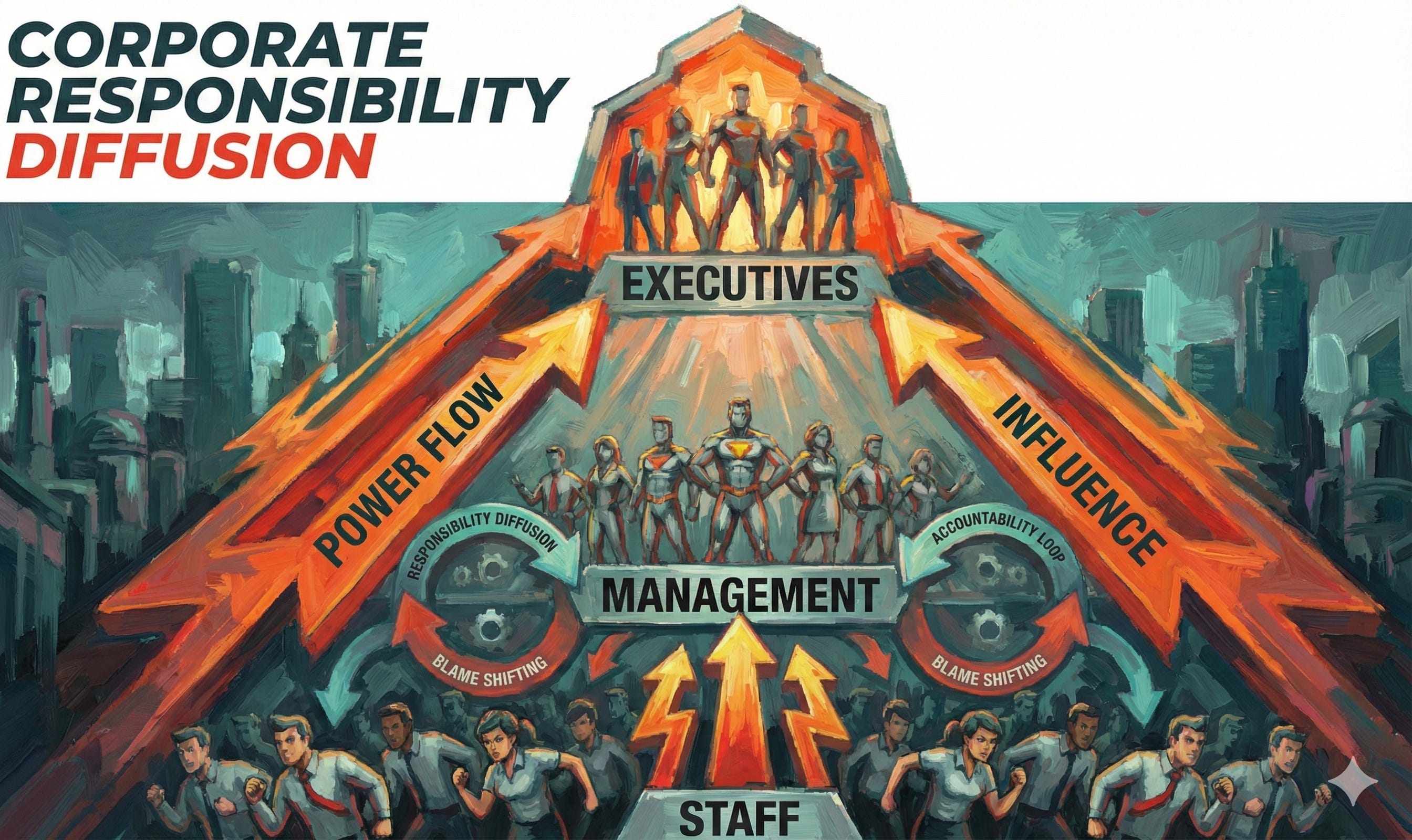
Diffusion of Responsibility (where there’s no individual responsibility, so everyone blames everyone else for dysfunction) protects executives from accountability. Decision-making gets concentrated in small groups high up the chain of command, but when things fail or don’t move the fingers get pointed back down the chain and everyone starts doing just enough not to get fired.
The result is the same loop: workers blame individuals while the oligarchic structure escapes scrutiny. The system protects itself.
How companies sabotage themselves into oligarchy
Before we look at the famous failures, it’s worth understanding how organizations create the conditions for oligarchic takeover. And I’m not kidding about the sabotage part.
The CIA’s 1944 Simple Sabotage Field Manual was designed to teach ordinary citizens how to disrupt enemy organizations from within. What’s darkly funny is that it reads like almost any corporate employee handbook when it’s really the blueprint for modern corporate dysfunction. A note to readers; this isn’t the first time I reference this document; I’m a broken record with it because the patterns are so easily recognizable.
Here’s what organizational sabotage looks like when mapped to modern corporate life:
Obsess over process: Insist that every task or decision follows rigid “processes” or “approval workflows.” Discourage any form of expedited action, citing the need for compliance or risk mitigation.
Committee paralysis: Delegate decisions to large committees under the guise of inclusivity. Advocate for endless brainstorming sessions and evaluations, ensuring no action moves forward without exhaustive review.
Demand documentation for everything: Require detailed written instructions for every task, regardless of simplicity. Use ambiguities in instructions to justify delays or revisions.
Perfectionism on low-stakes work: Demand flawless results on trivial deliverables while overlooking critical flaws in major projects.
Meeting mania: Schedule frequent meetings during peak productivity hours and ensure they run over time. Prioritize “updates” over actionable discussions.
Sound familiar? That’s because most modern companies have accidentally recreated these conditions without outside enemies. They’ve sabotaged themselves.
When too much change happens too fast for an organization like restructuring, mergers, and “transformation initiatives,” weak, or bad, or selfish hires can end up in charge. The company weakens and becomes susceptible to takeover, either by a bureaucratic oligarchy that genuinely doesn’t know what it’s doing (but are getting paid insanely to play like they do), or by private equity cosplaying as totally normal corporate executives, who knows exactly what they’re doing.
Why do these companies not fall apart faster?
You might wonder how companies can sustain this level of dysfunction for years.
The answer: brands are more important than you realize.
A strong brand and company can live off the shoulders of its originators for a LONG ASS TIME. Customers who’ve trusted a brand for decades keep buying out of habit. Suppliers keep working with you because switching costs are high. Employees keep working there because the name looks good on a resume and “the job market is tough right now.”
This creates a grace period where the oligarchy can operate with impunity. The company isn’t making good decisions, but it doesn’t have to. It’s coasting on brand equity built by people who left or retired years ago.
Eventually that equity runs out. But “eventually” can be a decade or more.
When oligarchies fail: General Electric
General Electric under Jack Welch provides a clear example. Between 1981 and 2001, Welch fired over 170,000 employees while GE’s market value soared from $14 billion to $600 billion. Wall Street loved him. Fortune magazine named him “Manager of the Century.”
But Welch built an oligarchy. He implemented "stack ranking”; automatically firing the bottom 10% of employees every year regardless of absolute performance. He slashed GE’s American workforce by half while nearly doubling its foreign workforce. He turned the company from a manufacturing powerhouse into a financial services firm, with GE Capital accounting for 40% of revenue and 60% of profit by the time he retired.
Access to Welch mattered more than ideas. Political skill mattered more than domain expertise. The company optimized for quarterly earnings and shareholder value while gutting the systems that created actual value.
When Welch retired in 2001, his succession process triggered a mass exodus of bitter executive talent. His handpicked successor, Jeffrey Immelt, presided over GE’s collapse. By 2017, Immelt stepped down and GE stocks posted their strongest growth in months just from the announcement. The company eventually split into three separate entities, unwinding Welch’s empire.
The oligarchy had a shelf life. Innovation died when access mattered more than ideas. Talent left when merit stopped correlating with advancement. Strategic blindness set in from echo chambers at the top. The terminal phase was insiders extracting value while the ship sank.
GE is a textbook oligarchy failure: the executives genuinely believed in what they were doing. They thought stack ranking created excellence. They thought financialization was innovation. They were wrong, but they believed it. That’s the difference from what happened at Sears.
Sears: When oligarchy turns to extraction
Eddie Lampert allegedly took oligarchy to its logical endpoint. After buying Sears in 2005, he didn’t just prioritize access over output. According to allegations in ongoing litigation, he stripped billions in assets from the company and transferred them to himself while serving as CEO, chairman, largest creditor, and landlord simultaneously.
Sears sued Lampert in 2019, alleging he “transferred billions of dollars of the Company’s assets to its shareholders for grossly inadequate consideration or no consideration at all.”
The alleged pattern was methodical:
He allegedly sold Sears’ best 266 retail properties to a real estate investment trust he controlled, Seritage Growth Properties, in deals that allegedly undervalued the properties by at least $649 million. Sears then paid rent back to Lampert’s company.
He allegedly rejected a $1.6 billion offer for Lands’ End from private equity in favor of spinning it off in a way that preserved his equity stake, netting ESL Investments at least $490 million while Sears got far less value.
He sold the Craftsman brand to Stanley Black & Decker for $900 million in 2017, stripping Sears of one of its most valuable assets.
Through it all, Lampert’s hedge fund allegedly owned roughly $2.66 billion in Sears debt, generating $200-225 million per year in interest payments from the dying company. When Sears filed for bankruptcy in 2018, Lampert bought it back through his hedge fund for $5.2 billion, acquiring the remaining assets.
The lawsuit eventually settled for $175 million in 2022. Lampert still has a net worth of $2.2 billion. The 175,000 workers who lost their jobs over that decade got nothing.
This is what the end stage can look like: not an oligarchy that doesn’t know what it’s doing, but one person, and a board to back them up, who knows exactly what they’re doing. Whether Sears started as an oligarchy or was always targeted for extraction is unclear. What’s clear is that it ended as methodical value extraction by someone holding every position of power simultaneously.
The warning signs
You can spot this transformation in your company before it reaches terminal phase. The pattern is predictable:
Decision-making groups get smaller and less diverse. Strategy sessions become performance theater for decisions made elsewhere, in private. The org chart matters less than “who has the CEO’s ear.” New initiatives require executive sponsorship regardless of merit.
Resource allocation follows relationships, not business cases. Projects with executive champions get greenlit despite weak fundamentals. High-performing teams get gutted to fund pet projects. Budget and headcount flow to whoever has access to power.
Information becomes currency instead of shared resource. “Need to know” replaces transparency. Unofficial channels like Slack DMs, dinners, and golf games matter more than official ones. Knowledge hoarding gets rewarded over knowledge sharing.
Merit signals break down completely. Output quality stops correlating with advancement. Political skill gets valued over domain expertise. “Cultural fit” means alignment with the power center. High performers leave. Political operators stay and advance.
Goal posts move constantly. If you feel like performance expectations shift every time you have a review, that’s not a good sign. It means the people evaluating you don’t actually know what success looks like.
The clearest signal: if you find yourself more worried about what your executives are going to say than about output quality and whether or not your solution or feature will actually work, the transformation is already underway.
What this means for you
Understanding this pattern won’t stop it, but it explains why talented organizations fail, why your work stopped mattering, and why hope keeps getting crushed despite obvious capability on the team.
If you’re staying
Map the actual power structure, not the org chart. Track resource flow and decision authority. Build relationships with power centers while maintaining output. Understand you’re playing a different game now. But keep in mind that the game is probably outside your ability to control or even influence it now. You’ll need to mentally separate yourself and your emotions from daily work because sabotage creates uncontrollable chaos and you need to protect yourself.
If you’re leaving
When interviewing, ask questions that reveal power structure. How do decisions actually get made? Can you walk me through a recent project that got killed and why? How have resource allocation priorities changed in the last year? Watch for oligarchic patterns in the interview process itself like who makes the final call, how transparent they are about decision-making, whether they can articulate why they’re hiring for this role now.
Long-term protection
Build career insurance. Portable skills matter more in oligarchic environments because the company’s shelf life is shorter than you think. Network externally. Save aggressively. Work on side projects. Recognize when you’re optimizing for a sinking ship. Document your work extensively. When the collapse comes, and it will, you’ll need to prove your output quality to your next employer.
In an oligarchy, your internal reputation means nothing outside.
Protect your well being
Here’s what matters most: corporate oligarchies systematically destroy the conditions that support human flourishing. They make personal security precarious by constantly restructuring. Relationships become transactional because everything is about political survival. They sever the connection between effort and outcome by concentrating decisions at the top. They consume all unstructured time with performative busy-ness.
Research on civilizations that sustained both technological advancement with happiness and wellbeing (Song Dynasty China, Edo Japan, the Haudenosaunee Confederacy) shows the same pattern. People in those societies had:
Material sufficiency (not wealth)
Non-transactional social bonds
Visible connection between effort and meaningful outcomes
Protected unstructured time
These four conditions reinforce each other. When one breaks, the others follow.

Corporate oligarchies break all four systematically. They’re not just bad at business. They’re machines for converting human capability into executive compensation while destroying the structural conditions that make work sustainable. That’s why recognizing oligarchic patterns isn’t important just for career survival, but for understanding when you’re investing your finite time on this earth in a system designed to extract value from you while providing nothing back.
You can’t fix the system alone. But you can see it clearly, protect yourself, and make informed decisions about where to invest your effort. And maybe, if enough people recognize the pattern, we stop treating corporate dysfunction as inevitable and start demanding the structural conditions that actually work.